We are tea country, quite literally. Kenya grows and exports some of the finest tea to the world. For millions of us, tea is more than a beverage; it is the fabric of our culture, a form of politeness, and a lifestyle. Serving tea is perhaps the warmest gesture Kenyans will extend to guests. Which explains why, across the East African country, the morning, late afternoon and hours before bed are never complete without a cup of tea.
Except that our tea isn’t the same anymore. A key ingredient has disappeared: milk. Over the last three months, this commodity has become harder to find and more expensive to buy.
But there’s more to the milk shortage than our tea thinning. In rural and urban Kenya, milk is a core part of the daily routine. It is consumed whole, is an ingredient in various dishes, and a livelihood for thousands of farmers in the Kenyan highlands.
So, where did our milk go?
The story began in June this year, when the World Meteorological Organisation (WMO) announced that El Niño conditions would emerge between June and August 2026, with an 80 percent probability, rising to 90 percent through the remainder of the year. Today, Kenya and most of East Africa are smack in the middle of this extreme weather phenomenon that’s expected to peak as we head into 2027.
El Niño connection
El Niño is a climate condition associated with changes in Pacific Ocean temperatures that influence weather patterns around the world. In East Africa, it is often associated with heavier-than-normal rainfall during the October-to-December short rains, with effects varying by season and location. Earlier this year, government officials attributed the milk shortage in the country to drought preceding the anticipated El Niño rains, with the lack of rainfall undermining pasture availability and forcing farmers to rely heavily on purchased feeds.
In many locales, many farmers expect El Niño rains. What many of them don’t know is that the immediate challenge of the prolonged dry conditions has as much to do with the phenomenon as the delayed rains.
In recent years, Kenya has experienced both destructive flooding and periods of inadequate rainfall as climate impacts intensify. Heavy rains have damaged farms, disrupted transport and destroyed stored fodder, while prolonged dry spells have left pasture depleted and water scarce. Both have an immediate and direct impact on dairy, a sensitive sector that depends on the availability of feeds and whose profit margins are thin. What and how much a cow eats and drinks determines milk production. When pasture is plentiful and water is readily available, dairy cows produce more milk. When the grass and other herbage dry up, farmers are forced to find alternatives, often turning to commercial feeds that are often out of reach for smallholder farmers, who form the backbone of Kenya’s dairy industry.
Animal feeds account for 55 to 70 percent of the total milk production costs. Expensive livestock feeds force farmers to make the difficult choice between spending more on these supplements or accepting lower milk yields.
This has been the case across more than a dozen milk-producing counties, including Nyeri, Kiambu, Nyandarua, Meru, and Nakuru, where degraded natural pasture and expensive animal feed has pushed milk production costs up.
To ease pressure on farmers, the Government of Kenya proposed several measures, including temporarily lifting duty on maize imports for animal feed in June, providing the much-needed relief to them. To sustain milk production, however, such interventions must be accompanied by longer-term measures to help farmers withstand climate-induced extreme weather conditions.
The Kenya Dairy Board has weighed in on the shortage, painting an even grimmer picture. According to statistics from the government agency, formal milk deliveries to processors fell from 84.4 million litres in June 2026 to 81.3 million litres in July. The supply would further decline to 75 million litres in August, putting pressure on processors and retailers attempting to maintain regular supplies to their customers.
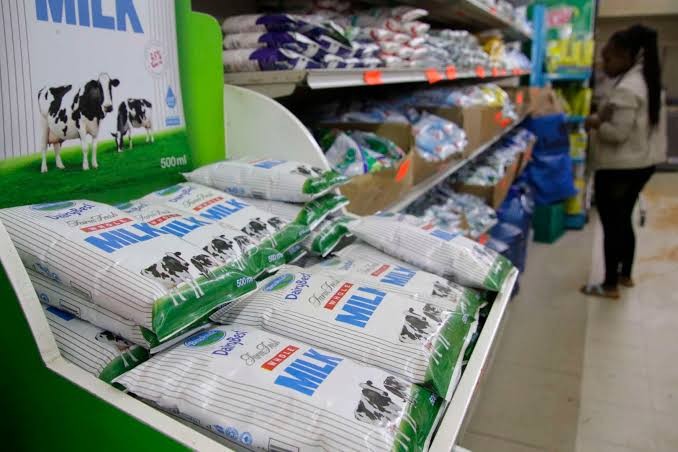
By September, a 500-millilitre packet of fresh milk rose by between Sh3 and Sh5, with some brands selling at Sh10 more. Still, the commodity flew off the shelves in a month when common brands disappeared. Other less common brands emerged before they, too, disappeared. By early October, customers were fortunate even to find powdered milk at the local store.
For three months now, supermarkets across Nairobi have been restricting the number of packets customers can purchase, mostly capped at three packets per buyer. For many shoppers, this has been an awkward experience to navigate.
For middle-class shoppers in Nairobi, an increase by a few shillings is seemingly negligible… until the cumulative budget line for milk destabilises the monthly shopping basket in a country where food price inflation has been a major talking point for the last few years. Some family friends have responded to this shortage by cutting down on milk consumption, and others by expunging it from their shopping basket altogether.
While households have felt the pinch, it’s small businesses, especially hotels and tea vendors, who have had the most significant dent on their livelihoods. When suppliers raise prices or deliver less milk than usual, traders must either absorb the additional cost or increase menu prices, the latter which has negative consequences on businesses.
This is a challenge that extends beyond individual farms, businesses, and households. It’s a climate issue as well as a supply chain issue. When cooperatives and processors receive less raw milk, distributors have smaller quantities to deliver, and retailers struggle to keep their shelves stocked. Consumers are forced to pay more for what’s available or go without the commodity.
For now, the test before Kenyan and East African farmers is to survive the period between the current depleted pasture and the return of the rains and fodder.
A storm that started deep in the Pacific Ocean swept across East Africa’s grazing field and found its way into an ordinary cup of tea.
While it is expected that the pressure on Kenya’s dairy industry will ease as soon as the rains arrive, climate projections show that extreme weather events will continue to grow in frequency in the coming years, destabilising not only the dairy sector but agriculture as a whole.
James Kahongeh leads media and communications at Power Shift Africa