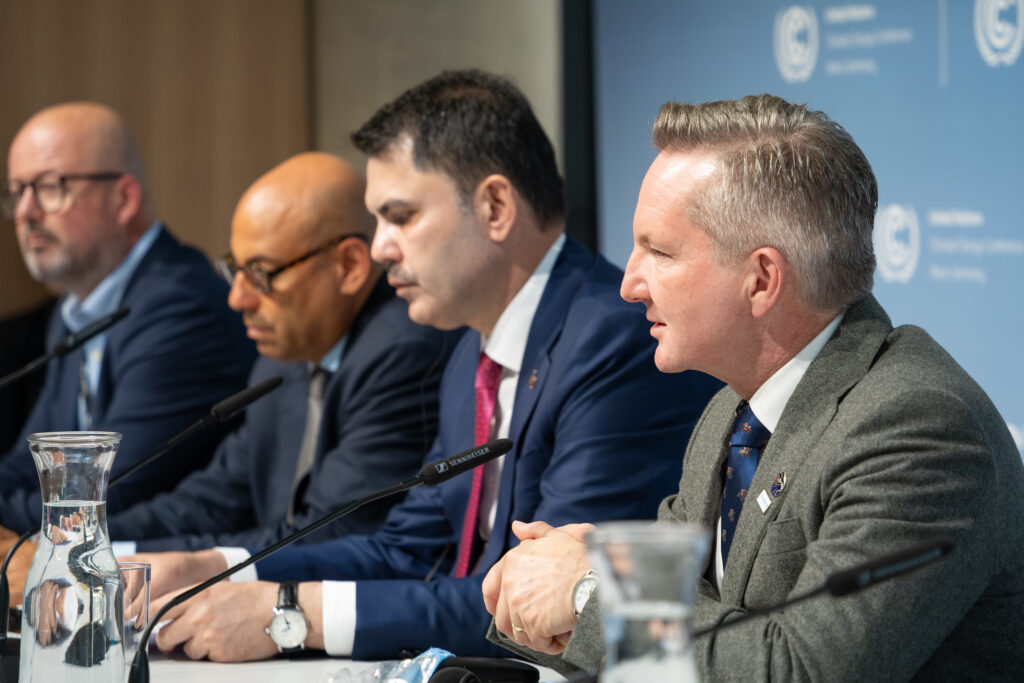
The ‘‘Summary of Reflections’’ is an informal note by the COP31 Presidency that records views that countries expressed in closed Presidency consultations on Tuesday and Wednesday this week about a proposed cover decision, the overarching political text meant to be the summit’s main negotiated outcome.
It is a high-level list of what countries would want to see. It is written down to support further discussion. The wish list does not name any country. Neither does it reflect consensus or the popularity of issues. Some points are generally agreed while others are proposed by a few. Often, Parties disagree on what should and should not be included, with room to submit more views as negotiations progress.
Fairness: the core demand
The Presidency’s document starts by reaffirming fairness and historical responsibility. It asks the text to acknowledge that wealthy nations caused most past emissions and have fallen short on climate action and funding. Retaining this language is crucial as it gives developing nations stronger backing when pushing for money and emission cuts. At the same time, the list avoids strict, top-down rules and stays neutral on technology, protecting developing countries from having a single economic path imposed on them.
Finance: the central battleground
Money is the longest section of the list and matches what developing nations want. It calls on wealthy countries to meet their Paris Agreement funding obligations, refill major climate and loss-and-damage funds, deliver $300 billion annually as agreed at COP29 in Baku, while scaling up to $1.3 trillion. It also calls on developed countries to triple adaptation finance by 2035. Crucially, developing countries want predictable grants rather than loans that worsen their debt crisis, alongside lower borrowing costs and easier access to funds.
Importantly, the text uses the soft phrase ‘‘pursuing efforts’’ to triple adaptation finance. Developing countries will be pushing for firmer, more explicit language, strict tracking rules, baselines, and deadlines. A target without deadlines is impossible to enforce. The document bluntly notes that wealthy nations have broken past pledges and shifted public money elsewhere, while some rich countries want to avoid extra pressure on their budgets. This clash will define the talks.
READ: Billions for defense, peanuts for climate action
Adapting to climate impacts
To address worsening floods, deadlier droughts, and increasing heat waves, the list highlights three priorities, namely, expanding disaster early warning systems, creating a funding program for mountain regions like the Himalayas and Andes, and closing gaps in climate data. For developing nations, the goal is to ensure adapting to climate change and paying for damages are treated as just as important as cutting emissions. With little to no emissions to cut, adaptation has been Africa’s main priority at climate negotiations.
READ: The world failed Africa on 1.5C, it can’t fail its adaptation
The overshoot
According to the Presidency, many countries want the final text to address how to limit the time and extent to which global temperatures pass the 1.5°C threshold. They also want a decision on how to bring them back down quickly. While this supports the push for more adaptation money, developing nations worry wealthy emitters will use it to rely on unproven carbon capture technologies instead of cutting emissions now. To prevent this, one contested request asks wealthy nations to reach net-zero emissions earlier than developing countries and then actively remove more carbon than they emit.
Energy goals
The list backs the global goal of 35 percent electrification by 2035, alongside more renewable energy, better power grids, and energy storage. It adds that this must respect national needs and keep energy affordable. However, without funding and technology transfers, a global target is just an unfunded burden for poorer nations. The text also calls for transitioning away from fossil fuels, ending wasteful subsidies, and cutting methane from energy and farming.
Director of Power Shift Africa, Mohamed Adow, says the 35 by 35 pledge could transform the global energy system but warns that without a commitment to replace fossil fuels and deliver affordable finance for Africa, it risks becoming another headline target that fails to deliver.
‘‘This is an enormous opportunity, particularly for Africa, where clean electricity could unlock a new era of industrial development and prosperity,’’ Adow says.
READ: COP31’s electrification goal rosks missing the point
But there is a serious flaw in the proposal, he notes.
He adds: ‘‘It promotes electrification without ensuring that the additional electricity comes from renewable sources or that it replaces fossil fuels. Electrification is not automatically decarbonisation.’’
Expect a fierce battle here.
Trade and science
Beyond finance, the list asks for a timeline to phase out unilateral climate trade measures, such as carbon border taxes, which developing exporters view as unfair trade barriers. It also asks that the next major UN climate science reports be finished in time for the next global review, though some nations want more time to ensure data from developing countries is included.
The wish list is a mixed bag for the Global South. It includes key priorities like historical responsibility, grant-based funding, and limits on carbon border taxes. But it also carries risks like relying on carbon removal and protecting wealthy nations from budget pressure. To that end, the final agreement will be judged on whether it sets firm deadlines to track the tripling of adaptation money, whether it explicitly requires wealthy nations to lead on emission cuts, and whether it takes real action against climate trade barriers.
The second week of this COP already has a lot to go over and decide.
James Kahongeh is the Lead, Media and Commnications at Power Shift Africa